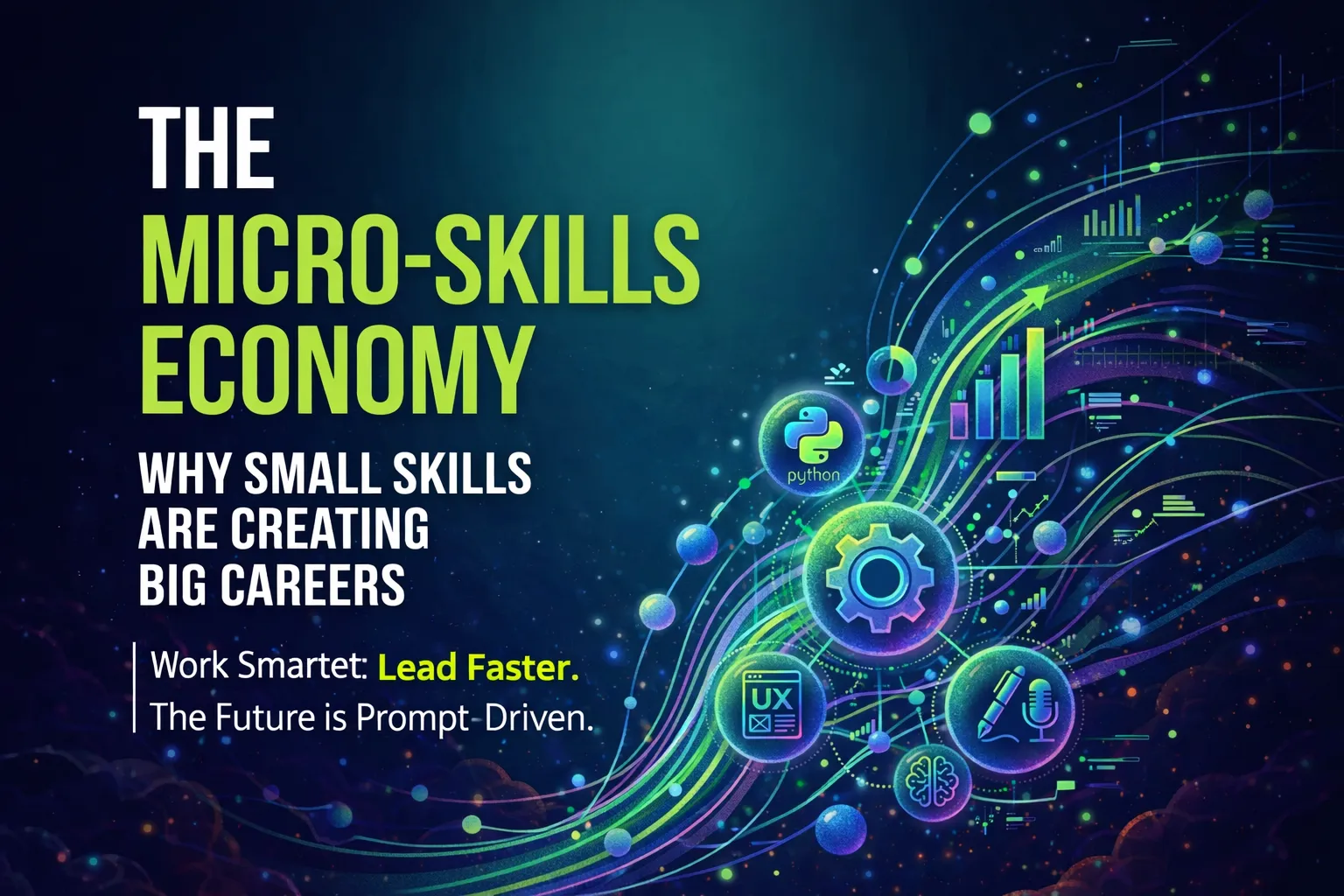
The Micro-Skills Economy: Why Small Skills Are Creating Big Careers
For many years, career advice focused on mastering one large discipline. Students were encouraged to choose a major field, specialize deeply, and build a career within that domain. While specialization is still valuable, the professional world in 2026 is evolving in a new direction. Instead of relying on a single dominant skill, many professionals are building careers by combining multiple smaller skills that work together. This shift has led to what many experts call the micro-skills economy.
Micro-skills are focused, specialized capabilities that solve specific problems. Individually they may seem small, but when combined they create a powerful professional profile. For example, someone who understands data visualization, API integration, automation tools, and prompt engineering can create value across many digital workflows. The ability to connect these capabilities allows professionals to adapt quickly as industries evolve.
In a world where technology changes rapidly, micro-skills provide flexibility. Instead of relying on one skill that may become outdated, professionals build a stack of complementary abilities that help them stay relevant and competitive.
Understanding the Micro-Skills Economy
The modern workplace is increasingly project-based and interdisciplinary. Teams are expected to move quickly, solve complex problems, and integrate multiple technologies at once. In this environment, professionals who can bridge different domains often provide more value than those who focus narrowly on a single specialization.
Micro-skills make this possible because they allow individuals to expand their capabilities without completely changing careers. Learning one small skill at a time can gradually build a broader skill set that supports multiple types of work.
For example, a marketer who learns data visualization can interpret campaign performance more effectively. A developer who learns automation tools can streamline workflows. A designer who understands basic analytics can measure user behavior more accurately.
Examples of Valuable Micro-Skills
Many micro-skills are emerging from the intersection of technology and business needs. Some of the most valuable ones include:
- Data visualization: Turning complex data into clear visual insights.
- API integration: Connecting systems and applications to share information.
- Prompt engineering: Communicating effectively with AI systems.
- Automation workflows: Reducing repetitive tasks through automation tools.
- Cloud deployment basics: Understanding how applications are hosted and managed.
Each of these skills is useful on its own, but when combined they enable professionals to solve broader problems. Someone who understands several of these capabilities can design workflows, automate processes, and interpret results more effectively than someone who only knows one tool.
Why Micro-Skills Matter in Modern Careers
One of the biggest advantages of micro-skills is adaptability. As industries evolve, professionals can add new skills to their stack without abandoning their existing expertise. This flexibility allows them to respond to emerging technologies and changing job requirements.
Employers increasingly value this adaptability. Instead of hiring individuals who only perform one narrow function, organizations often look for professionals who can collaborate across disciplines and contribute in multiple areas.
Micro-skills also encourage continuous learning. Because each skill is relatively focused, it can often be learned quickly through targeted practice and real-world projects. Over time, this incremental learning creates significant professional growth.
The Role of Skill Stacking
Skill stacking is the process of combining multiple complementary micro-skills to create a unique professional advantage. Instead of competing solely on one capability, professionals differentiate themselves through the combination of skills they possess.
For example, a professional who combines communication skills, data analysis, and automation knowledge can streamline business processes and present insights clearly to decision-makers. Another professional might combine coding knowledge, user experience design, and product strategy to build more effective digital products.
These combinations create unique value because they allow professionals to approach problems from multiple perspectives.
Building Micro-Skills Through Projects
The most effective way to develop micro-skills is through practical application. Learning concepts is helpful, but real understanding develops when skills are used to solve real problems.
Projects provide an excellent environment for building micro-skills. By working on small, focused projects, professionals can experiment with new tools and techniques while gaining hands-on experience.
For instance, someone learning automation might create a workflow that collects and organizes data automatically. Someone learning data visualization might build dashboards that interpret business metrics. These projects demonstrate capability and also strengthen problem-solving ability.
The Future of Work in the Micro-Skills Economy
As technology continues to evolve, the micro-skills economy is likely to expand. New tools, platforms, and workflows will create additional opportunities for professionals to build targeted skills that support emerging needs.
Rather than relying on a single career path, professionals will increasingly navigate dynamic skill combinations that allow them to contribute in different ways over time.
This shift represents a new approach to career growth. Instead of focusing only on titles and roles, professionals focus on building capabilities that enable them to solve meaningful problems.
In the micro-skills economy, small skills can lead to big opportunities. By continuously expanding their skill stack, professionals can stay adaptable and ready for the evolving future of work.
